Platform
One hop between your apps and every model they call.
Tokenomix is a proxy. Applications point at it instead of at the provider, and it does five things to every request before anything leaves your network. The provider can be a vendor API or a model on your own GPUs; the gateway treats both the same.
-
01
Identity
The validated API key resolves to a person and a department.
Never a client-supplied header. A caller can claim to be anyone; a key can only be the thing it is.
-
02
Quotas
Tokens, requests and spend checked against every limit that applies.
Runs before screening, so a request that is over budget costs no GPU time. Most restrictive limit wins.
-
03
Screening
Seven pattern detectors plus a fine-tuned classifier.
Jailbreaks, PII, secrets, prompt injection, toxicity, blocked topics and your own regex.
-
04
Policy
Block, warn, redact, log or allow. Strictest match wins.
Department rules layer on top of central rules and can only ever tighten them.
-
05
Audit
Verdict, tokens, cost and the deciding rule, on every call.
The row is written whether the request was allowed or stopped, which is what makes chargeback possible.
01 — The three jobs
Cost control and data control, in one place.
Most organizations buy these separately and end up with two sets of numbers that disagree. Running both off the same proxy means the spend report and the security report are built from the same rows.
Screening and policy
Catch what shouldn’t be in the prompt
Seven pattern detectors and a fine-tuned classifier, wired to a policy engine where the strictest matching rule wins.
Read on →
Chargeback and quotas
Give every dollar an owner
Spend attributed to a person, a team and an application. Then hard limits on tokens, requests and cost.
Read on →
Routing
Decide which model gets to see it
Constraints narrow the candidates, preferences pick one. A prompt carrying PII can be pinned to a local model.
Read on →
02 — The console
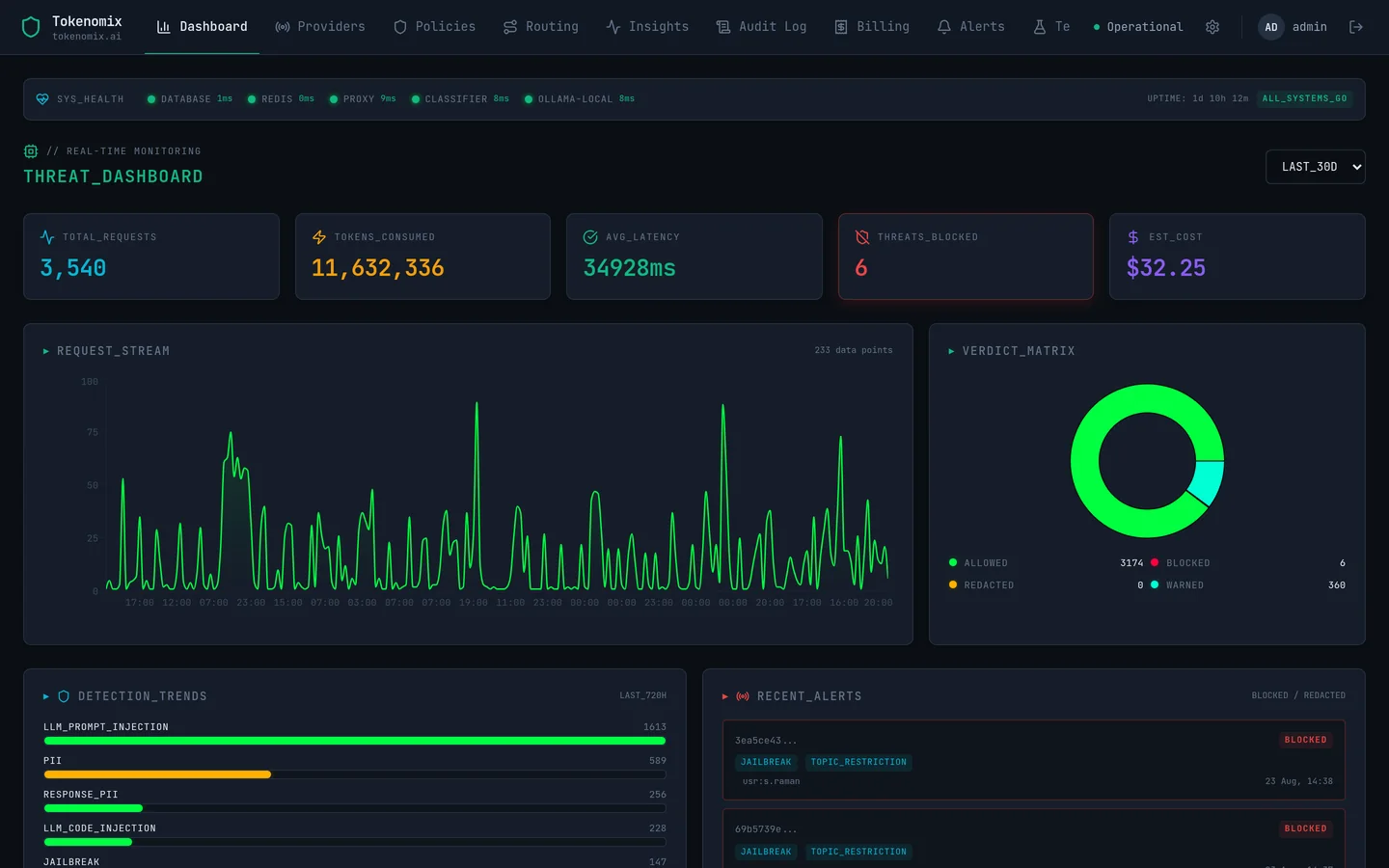
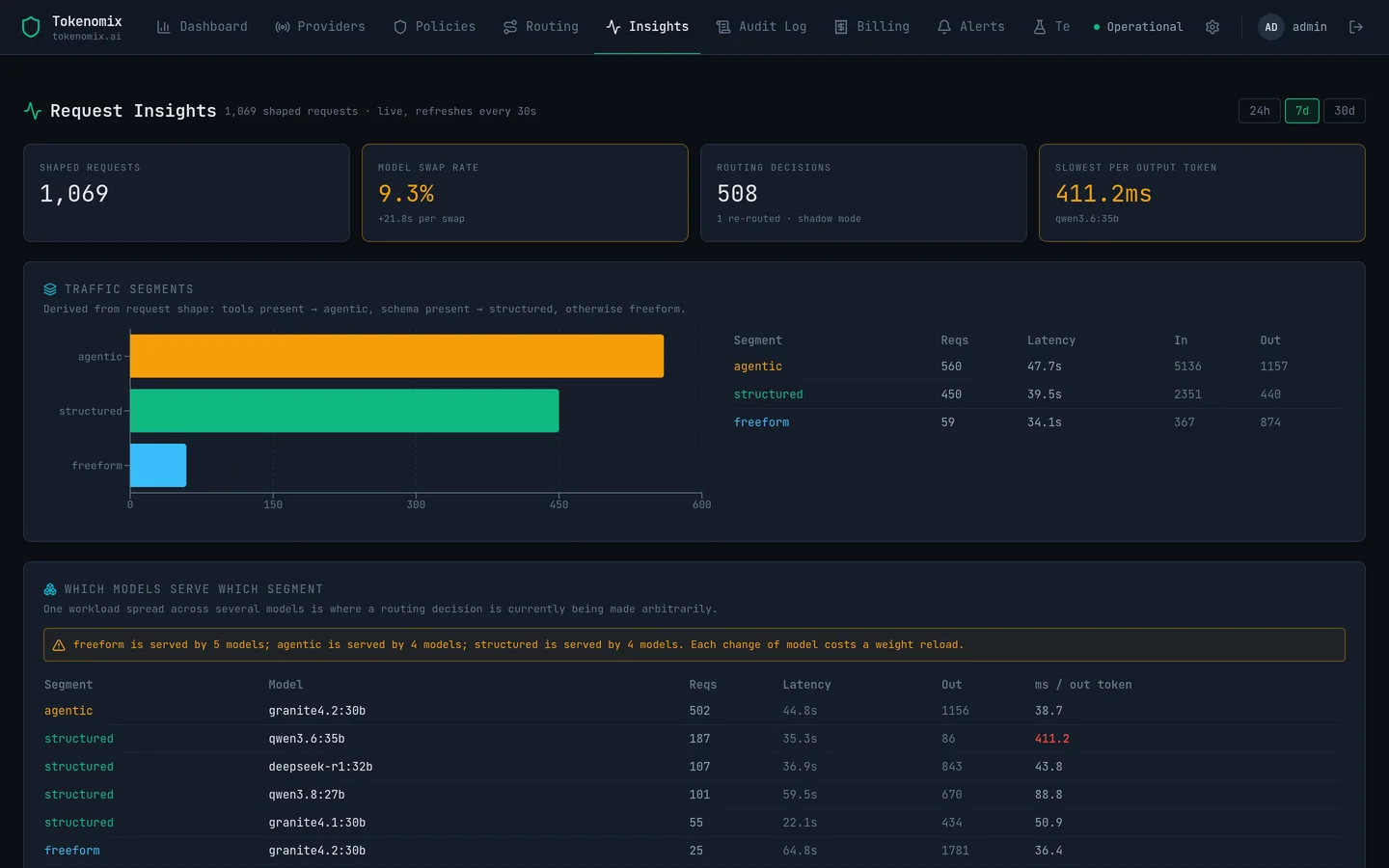
Where the day-to-day happens.
Admins see the whole estate. A department admin sees their own department and can only ever tighten what central IT set. An end user sees their own keys and their own spend, and nothing else.
03 — Fitting in
What it takes to put this in front of your traffic.
- OpenAI-compatible
- One base URL change. The chat completions and embeddings endpoints behave the way your SDK already expects, streaming included.
- Hosted vendor APIs
- OpenAI, Anthropic, Azure OpenAI, Google and Cohere. Keys live in the gateway rather than in forty application configs, encrypted at rest with a key you hold, and each provider’s own auth scheme is handled for you.
- Models you run yourself
- vLLM, Ollama or anything else speaking the OpenAI-compatible API, on-prem or in your own VPC. Same screening, same quotas, same chargeback rows. Self-hosted traffic is usually the half nobody is measuring, because it never shows up on an invoice.
- Streaming
- Streamed responses pass through and arrive the way they always did. The answer is screened for PII and secrets once the stream finishes, so a leak in a streamed reply still gets a verdict and an audit row.
- Identity
- Roles for admin, operator, viewer, department admin and end user. Personal API keys, minted and revoked per user, with the raw secret shown exactly once.
- Audit
- Every request row carries the verdict, the detector that fired, the deciding rule, tokens in and out, cost, and whether screening was bypassed.
- Export
- Chargeback downloads as CSV grouped by user, model, provider, department or application. Finance can take it straight into a spreadsheet.